The Complete Guide to Choosing an Acumatica Co-Delivery Partner
Published July 2026 by Envinse Technical Team · 9 minute read · For Acumatica VARs and resellers.
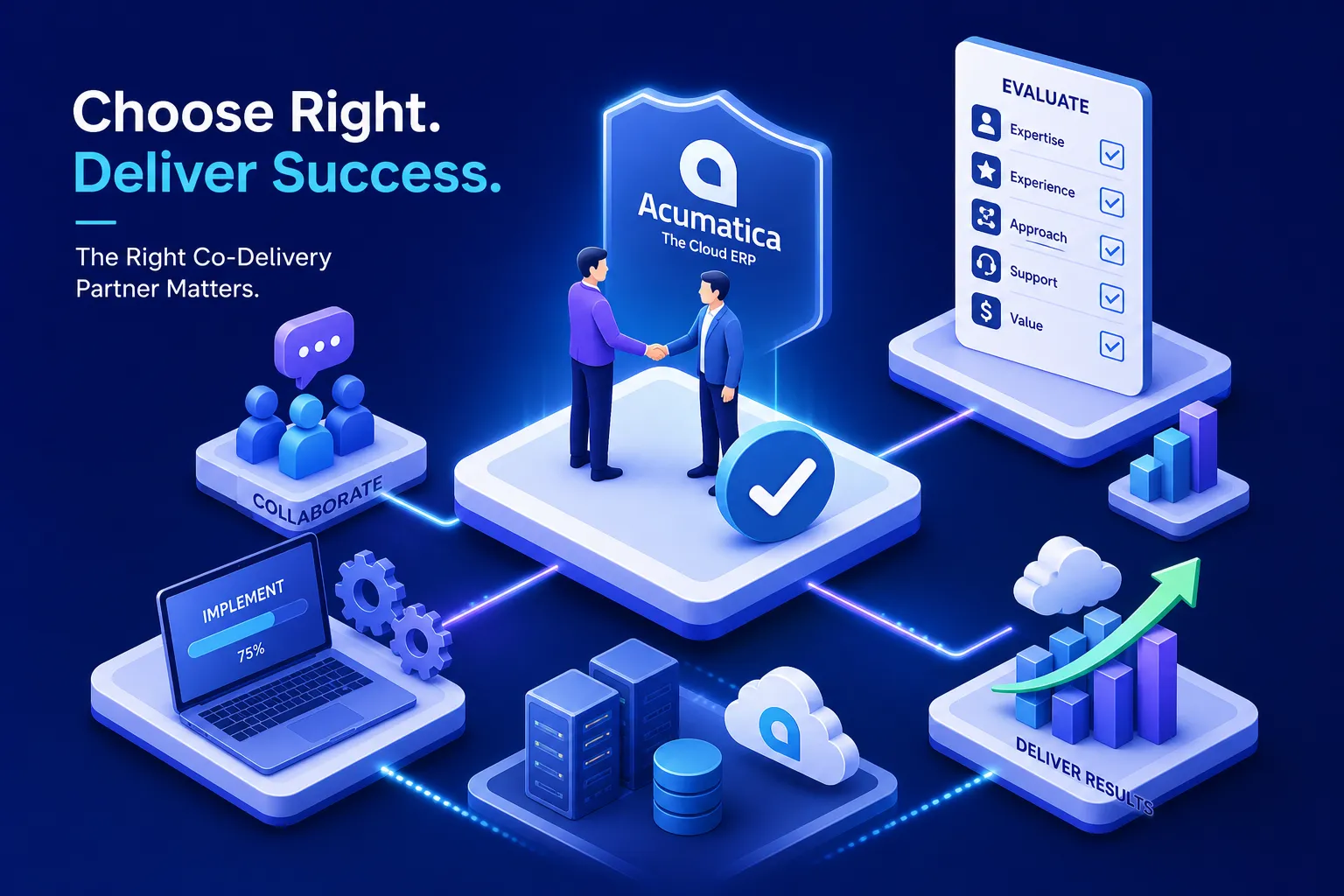
Your client wants a custom integration between Acumatica and their 3PL. The scope is clear, the deal is closed, and the delivery deadline is four weeks out. Your internal team is already stretched across two other active projects, and hiring a developer to handle this one build is not a realistic option. You can delay, turn down the work, or find someone who can step in without disrupting the client relationship. If you are a VAR searching for an Acumatica co-delivery partner for VARs and resellers, that third option is exactly what this guide covers.
In plain terms, co-delivery means bringing in a certified Acumatica development partner to handle the technical execution of a project while you, the VAR, maintain full ownership of the client relationship and the project outcome. It is not subcontracting in the traditional sense. It is a structured collaboration where the development partner operates as your technical arm, often invisibly, under your brand. This guide covers how co-delivery works in an Acumatica context, why the economics favor it in 2026, how to evaluate an Acumatica co-delivery partner before you commit, and which commercial terms to define upfront so the engagement runs smoothly every time.
What co-delivery actually means for an Acumatica VAR or reseller
Co-delivery is not an official Acumatica program category. It is worth noting that Acumatica does run a Fulfilled by Acumatica (FbA) program for ISVs who co-sell and co-deliver third-party applications through the channel, but that is a separate, ISV-specific mechanism. The co-delivery model discussed here refers to informal white-label arrangements with certified Acumatica implementation partners who choose to serve the channel rather than compete in it. Acumatica's partner ecosystem recognizes VARs, ISVs, and OEMs, and certified development firms operate within those structures. In practice, a co-delivery partner plugs into your operation and executes builds on your behalf instead of building their own direct client base.
The distinction between co-delivery and simple project outsourcing matters. Outsourcing a one-off project is transactional: you hand over a spec, someone builds it, and you move on. Co-delivery is an ongoing relationship. The partner learns your delivery standards, your client profiles, and your communication expectations. They integrate into your workflow rather than operating as a disconnected vendor you found on short notice.
How a co-delivery engagement runs from kickoff to go-live
The typical flow is straightforward. You scope the requirement with your client, brief the co-delivery partner with the technical specification, and the partner handles the build, testing, and documentation. You deliver to the client. In most engagements, the client never interacts directly with the development partner. All deliverables come back to you in a form ready to present under your brand.
Code that survives platform updates is non-negotiable in this model. Because you own the long-term relationship with the client, any customization that breaks during an Acumatica version update becomes your problem to explain. A qualified Acumatica co-delivery partner builds to Acumatica's coding standards, avoids schema-bound customizations that break during upgrades, and delivers documented code you can maintain or extend. That is a baseline requirement, not a differentiator. For practical maintenance and version-stability best practices, see 7 simple strategies for maintaining Acumatica like a pro.
Why VARs and resellers are turning to co-delivery partners in 2026
The financial argument is straightforward. Hiring a mid-level Acumatica developer in the United States carries a fully loaded cost of $110,000 to $180,000 or more per year when you factor in salary, benefits, payroll taxes, and the ramp time before that hire is productive on client work. For a VAR with variable project volume, that is a fixed cost that does not shrink when deal flow slows down. An Acumatica co-delivery partner converts that fixed cost to a variable one: you engage when there is work and pay for what you use.
The supply side reinforces this. Experienced Acumatica developers with three or more years of live customization work are genuinely difficult to find in the US market. Hiring timelines typically stretch three to six months when you factor in sourcing, interviews, and onboarding, with no guarantee the candidate has depth in your target verticals. A pre-vetted Acumatica channel partner eliminates that search entirely and gives you access to credentials that took years to build.
The capacity problem pushing VARs toward the co-delivery model
The pattern plays out in a predictable way. A VAR wins a deal that includes a complex workflow automation or a third-party integration, often a $50,000 to $150,000 engagement, and the internal team is already committed to active projects with fixed go-live dates. Delaying the new client damages the relationship before it starts. Turning down the work cedes revenue and potentially the account to a competitor. A co-delivery partner solves the capacity problem without forcing that choice, letting you commit confidently to scope and timeline from day one.
How co-delivery protects the client relationship
When the co-delivery partner operates under your brand, the client experience is seamless. Your client sees consistent communication, your project governance, and your name on every deliverable. The partner's involvement is invisible by design. This matters because the moment a client learns you brought in an unknown third party without disclosing it, the trust equation changes. A white-label capable Acumatica services partner with strict confidentiality practices keeps that equation intact.
Certifications and credentials that signal a trustworthy Acumatica co-delivery partner
Acumatica's partner tier structure runs from Authorized at the entry level through Certified, Silver, and Gold at the top. Gold Certified status is not a participation badge. It reflects demonstrated sales performance, deep technical proficiency, and a track record of successful implementations across the team. Annual recertification is required at every tier, but Gold partners maintain the broadest set of functional, technical, and industry-specific credentials. For a VAR evaluating an Acumatica implementation partner for co-delivery, Gold certification is a meaningful signal of verified Acumatica depth; see an external analysis of the benefits of working with an Acumatica Gold Certified partner.
Why certification tier matters more than company size
Certification tiers reflect cumulative Acumatica-specific credentials held across the partner's team, functional tracks like financials, CRM, and inventory management, plus industry certifications in manufacturing, distribution, and construction. Those credentials do not automatically guarantee fit for every engagement, but they do indicate how much of the team's time and investment has gone into Acumatica specifically. A large generalist firm with a Silver designation and twelve other ERP platforms in rotation will generally carry less platform-specific depth than a focused shop where Acumatica is the only product on the board. What you want is a partner whose entire operation is built around Acumatica.
US-based delivery as a practical requirement, not a preference
For VARs serving US clients, onshore delivery matters beyond time zone convenience. Many clients in manufacturing and distribution have explicit expectations about where their ERP customization work is performed, particularly when sensitive financial or operational data is involved. Time zone overlap, clear communication, and the ability to escalate quickly when a client issue surfaces are operational requirements. An onshore US-based Acumatica reseller partner removes those friction points entirely.
How to choose an Acumatica co-delivery partner for VARs and resellers
Generic vendor selection questions will not give you what you need here. The questions that matter are specific to Acumatica co-delivery: will this partner's code survive an upgrade? Can they respond fast enough to keep your deals moving? Will they operate cleanly under your brand without introducing complications?
Questions that reveal technical depth and delivery standards
Start with the technical fundamentals. Ask how the partner ensures upgrade compatibility across customizations, specifically, what their process is for testing against new Acumatica builds before handoff. Ask for documentation examples from prior projects and request references from engagements in your target industries. Ask whether they build to Acumatica's official coding standards and naming conventions, since non-standard code is the most common source of post-upgrade breakage. The answers will tell you whether their version-stable delivery approach is a real process or a talking point.
Questions that reveal how the relationship will actually work
The operational questions are equally important. What is their committed response time for new project briefs and active engagements? How do they handle scope changes mid-build? Do they support full white-label delivery, including documentation and deliverables in your name? What is their process when a build breaks after an Acumatica version update, and who bears the cost of the fix? These questions separate Acumatica VAR partners who are structured for co-delivery from those who are simply available for it.
Commercial terms and SLAs to define before you start
VARs often leave this vague on the first engagement, especially when the relationship starts well and trust is high. That mistake becomes expensive later. The commercial terms that protect both parties are not complex, but they need to be explicit before work begins.
Response time and escalation commitments
A co-delivery partner who cannot commit to a defined response time is not structured for the channel. VAR clients do not operate on flexible timelines, and neither should your development partner. Define expected turnaround for initial scoping responses, active project status updates, and post-delivery support separately. A 24-hour response window for new briefs and active engagements is a reasonable working benchmark, structure it as at least two distinct tiers in your SLA: standard requests within one business day, and Severity 1 production issues at two hours or less. These numbers should appear in writing, not just in conversation.
Code ownership, IP clarity, and upgrade support commitments
Every build delivered through a co-delivery engagement should come with a written commitment covering upgrade support obligations. Rather than a blanket warranty that code will never break, what you are looking for is confirmation that the partner builds to Acumatica's published coding standards and that they will provide remediation support if their code is affected by a standard platform update. Equally important is IP clarity: confirm that the delivered code is owned by you or your client, not held by the development partner, and that it can be redeployed or modified without restriction. Document both points in the engagement agreement before work begins.
Why Envinse is built for Acumatica VAR co-delivery
Envinse is a US-based Acumatica Gold Certified Service Provider that has structured its operation around serving VARs as a white-label co-delivery partner. The team builds within the Acumatica ecosystem, which means no divided attention across other ERP platforms and close familiarity with the platform's release cadence and upcoming changes. For VARs looking for an Acumatica co-delivery partner for VARs and resellers, that single-platform focus translates directly into fewer surprises at go-live and cleaner code over the long term. Full details of how white-label Acumatica development works at Envinse, including engagement models and NDA terms, are on the VAR partners page.
What Gold Certified status and documented response commitments mean in practice
Gold Certification at Envinse reflects a team with functional, technical, and industry credentials across the Acumatica platform, including financials, CRM, manufacturing, and distribution tracks. Envinse commits to a 24-hour response window for new briefs and active engagements, a term that should be confirmed in your engagement agreement, as with any co-delivery partner. For VARs managing multiple active deals, that kind of defined turnaround reduces one of the more common sources of project uncertainty: not knowing when your development partner will respond.
How Envinse's tool suite supports faster VAR delivery
Beyond custom development, Envinse offers a set of ready-to-deploy Acumatica tools built to accelerate delivery on common client requirements. These include AP invoice automation using AI and OCR to reduce manual data entry for finance teams, a QuickEdit tool for spreadsheet-style bulk editing of Acumatica records without developer involvement, AI email processing that creates leads, cases, or orders from unstructured inbound emails, and Smart Tags for labeling, filtering, and workflow automation across record types. For VARs, deploying a proven accelerator rather than building from scratch on every engagement compresses timelines and reduces delivery risk. Envinse's tools are built to Acumatica's coding standards, which means they are designed with version stability in mind, though you should confirm compatibility specifics for your client's version during scoping.
Choosing the right Acumatica co-delivery partner changes what deals you can take
The core decision here is not just about finding someone who can write Acumatica code. The question is whether the partner is structured for the channel: Gold Certified, responsive to defined SLAs, committed to version-stable delivery, and able to operate under your brand without friction. VARs who get this right expand the deals they can win, protect the client relationships they have built, and develop delivery capacity that scales without the cost and risk of growing an internal development team. For additional context on partner programs, review the Acumatica Partner Referral Program datasheet.
If you have an active project or an upcoming deal where development capacity is the constraint, reach out to Envinse directly. The conversation starts with your current scope and what you need to get the project moving. If you need an Acumatica co-delivery partner for VARs and resellers, Envinse is structured to step in fast, deliver cleanly, and help you close the work your clients are already asking for.
Get a Fixed-Price Quote - We Respond Within 24 Hours
Email: acumatica@envinse.com · Phone: 737-377-3839
Get a Fixed-Price Quote →